
From physical AI to agentic AI, the next phase of industrial transformation is about turning intelligence into action.
From October 21–23, SIMACRO participated in Industrial AI EXPO 2026 at KINTEX in Ilsan, South Korea, joining industry leaders, technology providers, and engineers to explore how artificial intelligence is reshaping industrial operations.
We were pleasantly surprised by the diversity of visitors to our booth, welcoming both domestic and international attendees. It was especially rewarding to reconnect with familiar faces and established partners while meeting new companies interested in exploring industrial AI applications. We appreciated the thoughtful conversations and look forward to continuing these discussions in the coming weeks.
Beyond the exhibition floor, the event offered a full schedule of insightful seminars and keynote presentations. While many discussions focused on physical AI, robotics, and manufacturing automation, several key messages resonated strongly with SIMACRO's perspective on industrial AI adoption.
Start with the Use Case, Not the Technology
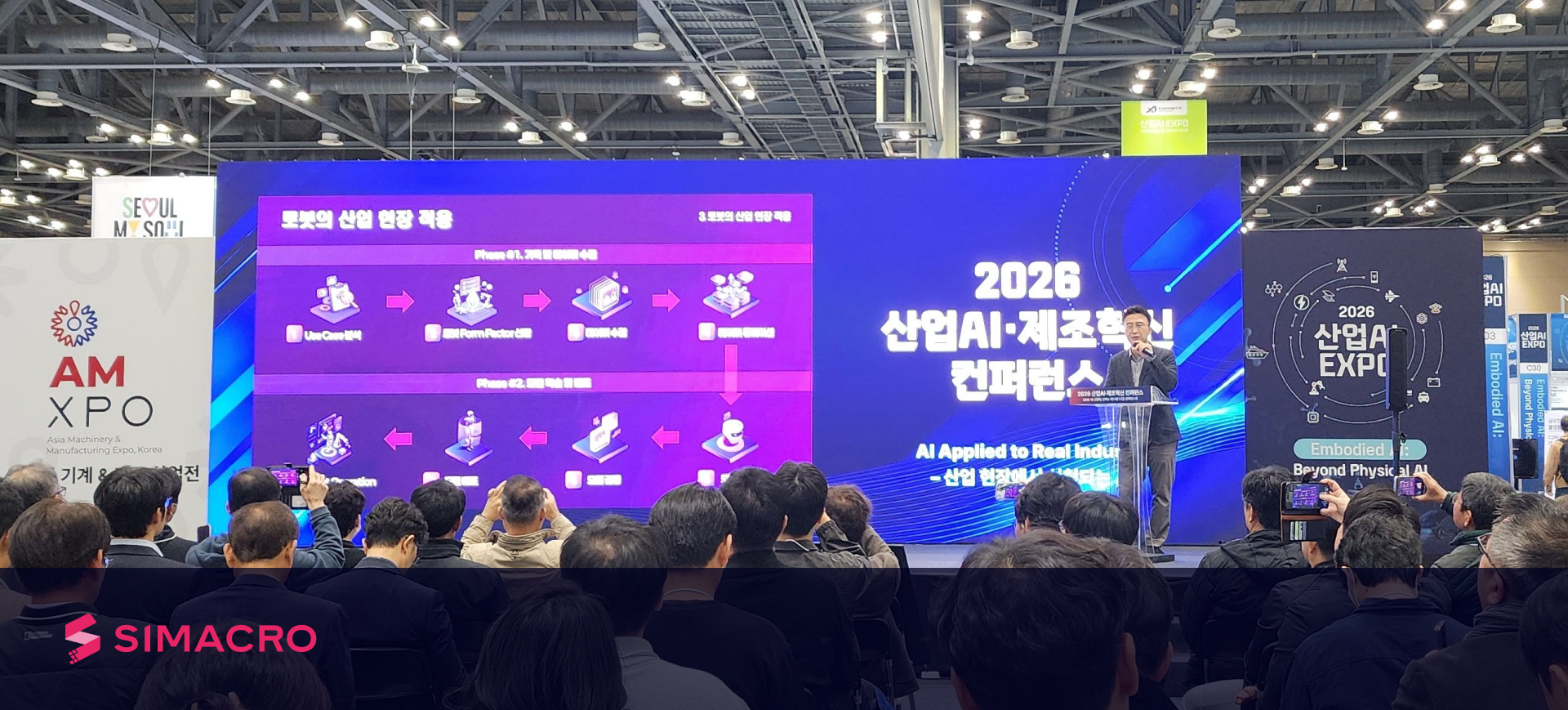
Dongshin Son from LG CNS presents a key note session at Industrial AI. PC: Angela Park
One particularly interesting presentation was "Physical AI와 휴머노이드가 이끄는 산업 AX의 미래" (The Future of Industrial AI Transformation Driven by Physical AI and Humanoids) by Dongshin Son (손동신), Future Robotics LAB, LG CNS.
Although the presentation primarily focused on physical AI and humanoid robotics in manufacturing environments, one key message resonated strongly with SIMACRO: successful AI adoption starts with identifying meaningful use cases and understanding the data required to address them.
Rather than implementing AI simply because the technology is available, organizations should first identify the operational challenges they want to solve, determine what data and tools are needed, and establish how AI can deliver tangible value.
This aligns closely with SIMACRO's approach to developing AIMIE™, our agentic AI system. Instead of building general-purpose AI agents without clearly defined applications, we are developing specialized agents designed to address specific engineering challenges.
Our current AIMIE™ beta focuses on two independent use cases:
Surrogate Modeling Agent: Automates multi-step workflows involving simulation execution, data generation and preparation, AI/ML model training, and performance evaluation. This helps engineers develop surrogate models while reducing repetitive manual work.
Optimization Agent: Focuses on optimization, coordinating computational steps to explore operating conditions and identify promising parameters within defined process constraints.
Both agents are designed around practical engineering objectives, with AI coordinating the necessary tools and computational steps rather than simply providing text-based recommendations.
At Industrial AI EXPO, we were pleased to demonstrate AIMIE's surrogate modeling agent, offering visitors a glimpse into how specialized agentic AI can transform traditionally manual engineering workflows.
The takeaway is simple: industrial AI should not begin with asking what AI can do, but with identifying what engineering problems AI should help us solve.
AI Governance: Building Intelligence We Can Trust
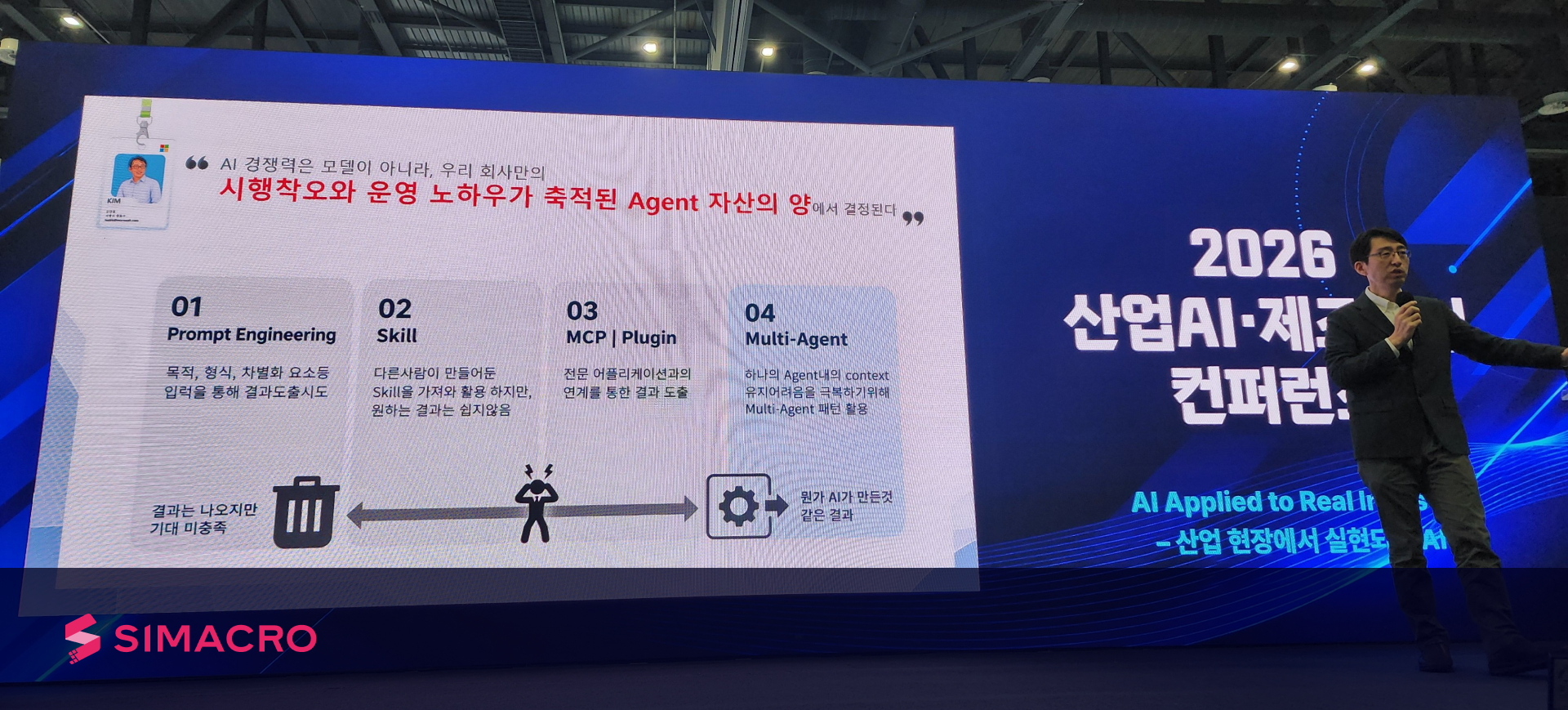
Hangyeol Kim from Microsoft presents a key note session at Industrial AI. PC: Angela Park
Another thought-provoking keynote was Microsoft's "산업 AI의 다음 단계: 인간의 비전을 지능과 신뢰로 실현하다" (The Next Stage of Industrial AI: Realizing Human Vision Through Intelligence and Trust), presented by Executive Director Hangyeol Kim (김한결).
Two topics particularly stood out: AI token monitoring and AI governance.
As AI becomes increasingly embedded in enterprise workflows, organizations must consider not only what AI can accomplish but also how it is used, managed, and monitored.
Token usage, for example, introduces new operational and cost-management considerations. As organizations move from occasional chatbot interactions toward AI agents that execute multiple steps, call external tools, and perform repeated evaluations, resource consumption can become significantly more complex.
At the same time, AI governance becomes essential for establishing accountability, controlling access to sensitive information, and ensuring that AI-generated outputs are reliable and traceable.
These considerations are particularly relevant to industrial environments, where AI recommendations may influence engineering decisions with real operational and economic consequences.
For industrial AI to scale, intelligence must be accompanied by transparency, validation, and appropriate human oversight.
Beyond Search: Are We Fully Utilizing AI?
One question that stayed with us throughout the event was:
How many organizations are truly going beyond using large language models (LLMs) for search, summarization, and question-answering?
LLMs have made AI more accessible than ever. Today, many professionals regularly use AI to retrieve information, draft documents, and accelerate everyday tasks.
These capabilities are valuable, but they represent only a fraction of AI's potential.
The next opportunity lies in agentic AI, where AI moves beyond generating responses to coordinating and executing multi-step workflows.
In industrial applications, this means enabling AI agents to automate technical tasks, validate results, and support optimization toward defined engineering objectives.
For example, rather than simply answering a question about process performance, a specialized industrial AI agent could:
Interpret an engineering objective and identify the required computational steps.
Execute approved engineering models to generate simulation data.
Process and prepare the generated data for analysis.
Train and evaluate AI/ML models, checking whether the results meet defined performance criteria.
Recommend additional calculations or adjustments to improve the results.
Such workflows can reduce repetitive engineering tasks and accelerate analysis while preserving human oversight of critical decisions.
However, industrial agentic AI requires more than an LLM connected to tools. It needs access to validated engineering models, reliable operational data, and a framework that manages how these resources are executed and governed.
This is where Industrial ModelOps becomes essential.
SIMACRO's Perspective: Connecting Industrial ModelOps with Agentic AI
At SIMACRO, we see Industrial ModelOps as an important foundation for translating AI capabilities into practical industrial applications.
Through ProcessModel V™ (PMV™), engineering teams can integrate and manage physics-based simulations, AI/ML models, and process data within a connected environment. This provides the model infrastructure and engineering context necessary for reliable analytical workflows.
Building on this foundation, AIMIE™, SIMACRO's agentic AI system, is being developed to automate specialized engineering workflows with limited human intervention.
During Industrial AI EXPO, we demonstrated AIMIE's surrogate modeling agent, which coordinates multiple steps, from executing engineering simulations and preparing generated data to training and evaluating AI/ML models. We have also developed a specialized optimization agent that, for example, can perform PVC batch recipe optimization.
These independent applications illustrate how agentic AI can accelerate engineering workflows while keeping the underlying computations connected to engineering models and defined performance objectives.
Our vision is not simply to introduce AI into industrial software, but to make engineering intelligence more accessible, reusable, and actionable.
Looking Ahead
Industrial AI EXPO 2026 reinforced several important lessons for us.
AI adoption should be driven by clearly defined use cases and the right data. AI governance and cost transparency must evolve alongside growing capabilities. And perhaps most importantly, the industry's next opportunity lies in moving beyond conversational AI toward systems that can execute, validate, and optimize complex workflows.
The transition from AI as an information assistant to AI as an engineering workflow partner will not happen through language models alone. It requires a strong foundation of engineering models, operational context, trustworthy execution, and human expertise.
The future of industrial AI is not just about generating better answers. It is about turning those answers into validated actions that deliver measurable industrial value.
We thank everyone who visited SIMACRO at KINTEX and the speakers who shared their perspectives. We look forward to continuing these conversations and advancing practical industrial AI adoption together.
Written by Angela Park
SIMACRO media team | media@simacro.com
