
How SIMACRO’s AIMIE coordinates engineering tools to automate complex, multi-step workflows in PMV.
Engineering analyses often require more than a single calculation. Engineers must prepare data, configure models, execute calculations, evaluate results, and determine the next steps. Even when individual tools are available, coordinating the full workflow can require considerable manual effort.
SIMACRO is developing AIMIE™ (AI for Machine Intelligence & Excellence) to simplify this work within ProcessModel V™ (PMV), SIMACRO’s open digital twin ModelOps platform. AIMIE’s specialized agents (beta version) automate multi-step engineering workflows with limited human input. They can run models, generate and process simulation data, prepare inputs for AI/ML model training, train and evaluate the resulting models, and suggest additional simulation runs based on the results.
Two use cases illustrate this approach: a surrogate modeling agent that automates the conversion of physics-based simulation models into AI/ML surrogate models in five steps or fewer, and an optimization agent that searches for improved operating conditions using the engineer’s selected simulation model. Each agent independently orchestrates a specialized, multi-step workflow with minimal human intervention.
Last week, SIMACRO demonstrated AIMIE’s surrogate modeling agent at the industrial AI conference at KINTEX in Ilsan, Korea, showing how an engineer’s request can initiate a coordinated workflow spanning simulation execution, data preparation, and AI/ML model training.
Use Case 1: Surrogate Modeling
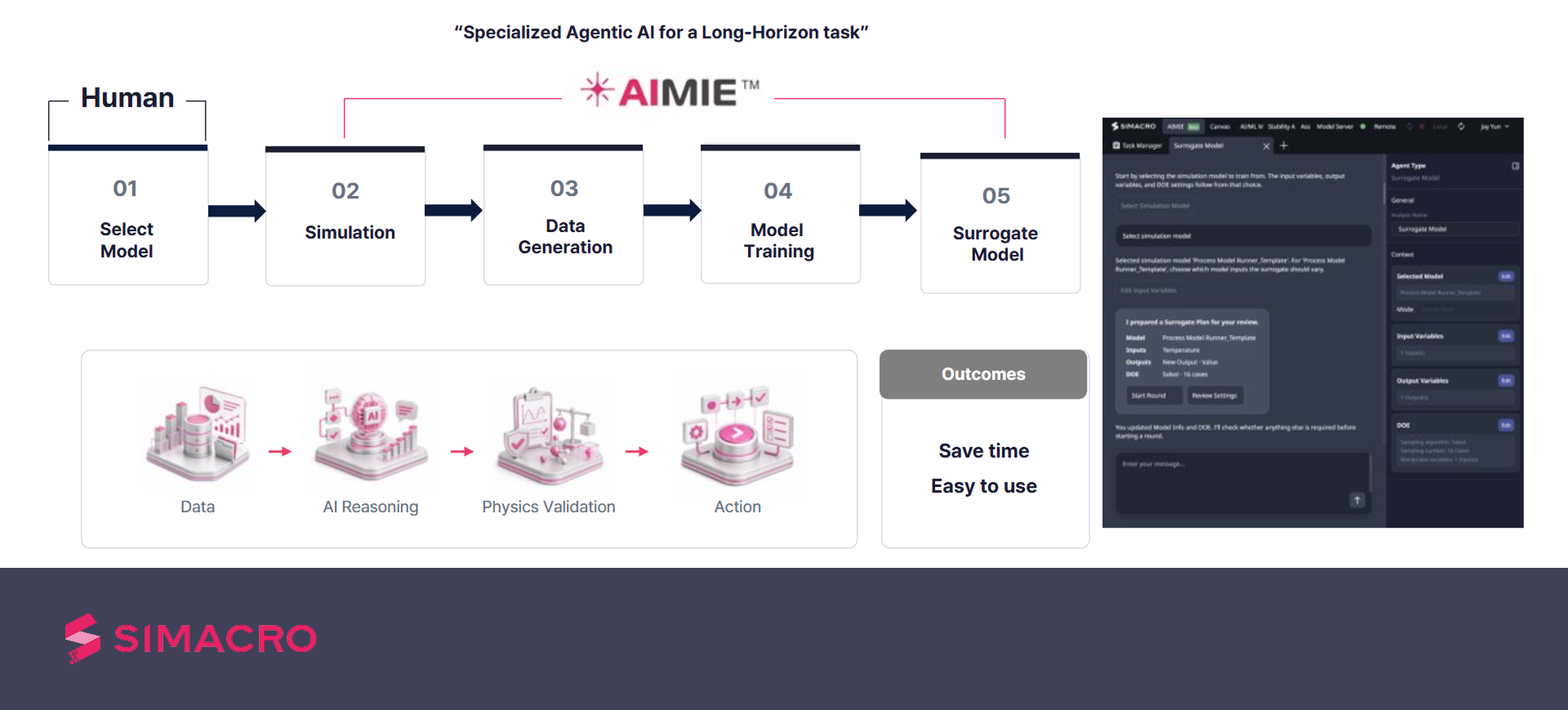
AIMIE-enabled long-horizon surrogate modeling workflow. Following the engineer’s initial model selection, AIMIE coordinates a multi-step workflow involving simulation execution, data generation, and model training to produce a surrogate model. By orchestrating specialized engineering tools and AI-driven reasoning within a structured workflow, AIMIE reduces manual intervention, saves time, and simplifies complex engineering analyses.
Detailed process simulations help engineers understand process behavior, but repeatedly executing a complex model can take substantial time. A surrogate model approximates selected input-output relationships from the source model using AI, enabling faster evaluations within a defined range.
Creating a useful surrogate involves much more than selecting a machine learning algorithm. Engineers must define input ranges, generate enough runs to collect enough simulation data, train AI/ML models multiple times and evaluate whether the trained model meets its intended purpose.
AIMIE’s surrogate modeling agent is designed to coordinate these tasks through a natural language interface. Its workflow is broadly applicable across simulation-based modeling use cases, subject to the available source models and supported tools.
An engineer could begin with a request such as:
“Build a surrogate model from this process simulation to predict these output variables across the specified input ranges.”
The engineer defines the source model, input and output variables, sampling ranges, and performance requirements. AIMIE then coordinates the workflow:
Generate simulation data. Execute the source model across the specified input conditions and identify unsuccessful runs that require handling or review.
Prepare the dataset. Organize simulation outputs and invoke data-processing tools to prepare training and evaluation data.
Train and evaluate the surrogate. Invoke AI/ML tools and compare predictions with source-model results against the defined acceptance criteria.
Present results for engineering review. Bring together the model’s performance, limitations, and intended operating range for assessment.
Before operational use, engineers should review the resulting surrogate against its intended application. Its reliability depends on the source model, the coverage and quality of the generated data, and the conditions under which it will be used.
By coordinating this workflow, AIMIE can reduce repetitive work and simplify the development of surrogate models while preserving engineering oversight.
Use Case 2: Optimization
AIMIE’s optimization agent helps engineers find recipes and operating conditions that improve process performance while meeting defined requirements. Depending on the user’s objective and selected simulation model, this can mean reducing production time or energy demand, or increasing product purity. Its workflow is broadly applicable across simulation-based optimization tasks, subject to the available source models and supported tools.
Engineers often evaluate alternatives by adjusting input values, running simulations, and comparing results before deciding what to test next. AIMIE automates this iterative search, helping engineers identify promising conditions for further verification with less manual trial and comparison.
The engineer selects a source simulation model, provides baseline conditions, chooses the variables that may be adjusted, and defines a target and constraints. The baseline establishes starting performance for comparison; the target specifies what to minimize or maximize; and the constraints define the requirements that acceptable results must satisfy.
An engineer could begin with a request such as:
“Find operating conditions that reduce production time while keeping product quality within the required range.”
AIMIE then coordinates the optimization workflow:
Establish the baseline and search settings. Run the source model with the baseline inputs and confirm the adjustable variables, target, and constraints.
Generate and simulate candidate conditions. Evaluate defined n candidate conditions per iteration using the selected simulation model to explore how changes in the adjustable variables affect the results.
Search and refine. Train and select surrogate models, use numerical optimization tools to identify promising conditions, and evaluate those conditions against the source simulation model. Update the search region and repeat until the completion criteria are met.
Present results for engineering review. Compare the best conditions found with the baseline, showing changes in the adjustable variables, improvement in the target, and whether the constraints are satisfied. Engineers can ask questions, adjust settings, and rerun the analysis.
PVC batch time optimization is one example of this workflow. Using a PVC polymerization simulation model, the engineer selects Temperature_Setpoint as the adjustable variable, sets Batch_Time as the target to minimize, and requires PVC_IV to remain between 0.91 and 0.94. AIMIE searches for a temperature setpoint that shortens the modeled batch time while meeting this quality specification. A shorter batch time could allow more batches and higher annual production, subject to other production limits.
In this example, AIMIE checks the recommended conditions against the source simulation model and presents them for engineering review and laboratory verification before plant use. Across applications, the selected simulation model and numerical tools perform the underlying calculations, while AIMIE coordinates the search and explains the results. The process being optimized depends on the engineer’s chosen model, objective, and constraints.
Specialized Agents, Governed Engineering Workflows
These use cases demonstrate AIMIE’s approach to agentic AI: specialized agents that coordinate defined engineering workflows using the tools and context relevant to each task.
PMV provides the environment for connecting engineering models, data, and execution tools. Industrial ModelOps supports the lifecycle practices needed to manage those resources, including versioning, validation, traceability, and monitoring. AIMIE adds the reasoning and orchestration that turn an engineering objective into a sequence of executable tasks.
Throughout each workflow, specialized models perform the technical calculations, and engineers assess whether the results are reliable and appropriate for their intended use.
Through its surrogate modeling and optimization workflows, AIMIE is advancing a practical role for industrial AI agents: reducing manual coordination so engineers can spend more time interpreting results and making informed decisions.
Written by Angela Park
SIMACRO media team | media@simacro.com
