
Evolution of Separation Processes Part 2: From Distillation Workhorses to Precision Chromatography
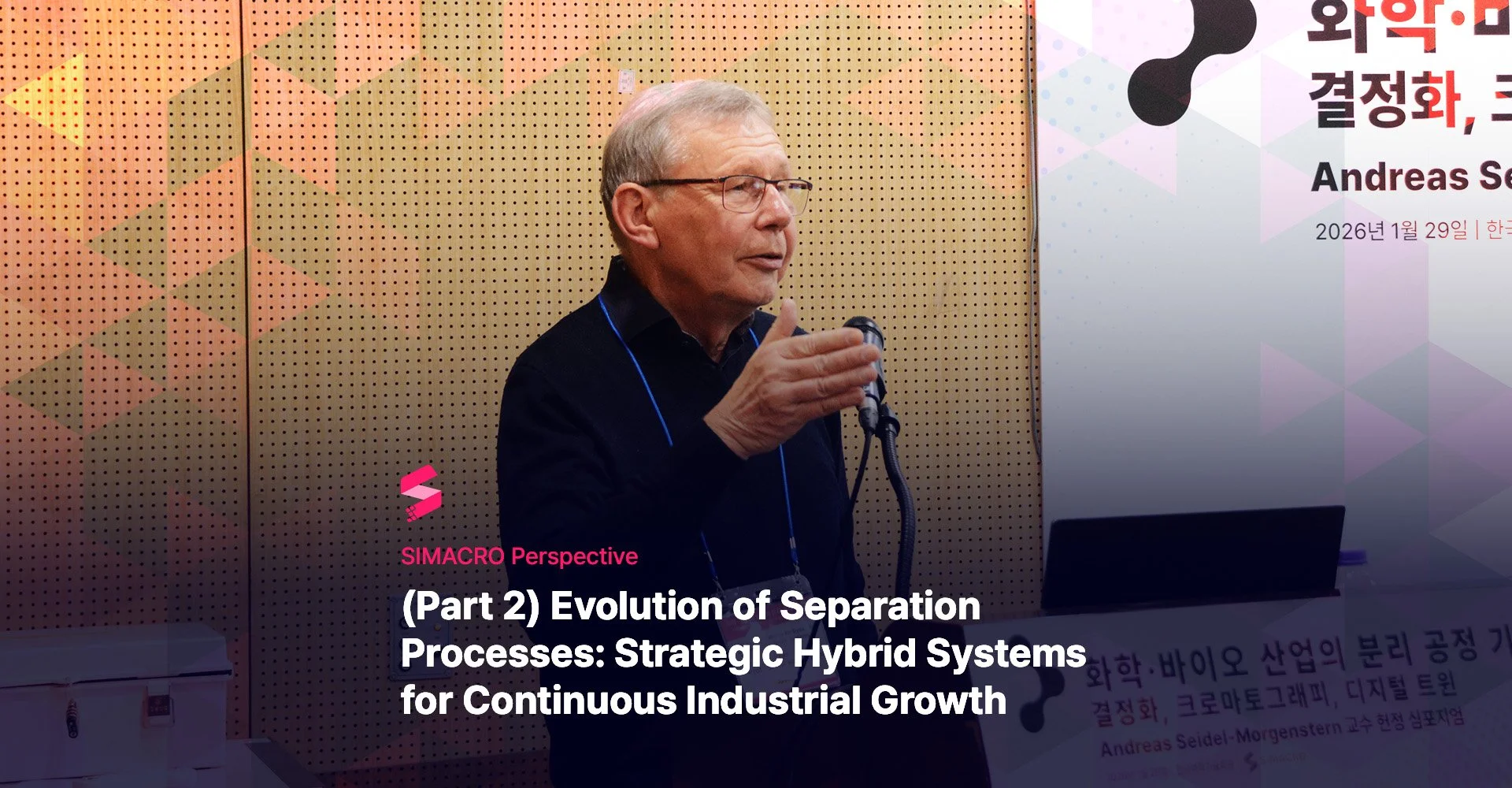
Building on the foundational principles of separation, industrial innovation now focuses on hybridizing technologies to maximize yield and achieve extreme purity. The transition from batch to continuous processing requires a deep understanding of both thermodynamics and kinetics. In our previous exploration of separation foundations, we established the critical roles of traditional units and the rising need for precision. Continuing our review from Professor Andreas Seidel-Morgenstern (ASM)’s plenary lecture, this second part dives into the strategic hybridization of technologies. Professor Seidel-Morgenstern, a former Director at the Max Planck Institute for Dynamics of Complex Technical Systems and a long-standing partner of SIMACRO, emphasizes that industrial innovation now focuses on maximizing yield and achieving high purity through continuous processing. When academic rigor is coupled with industrial operational excellence, even complex challenges like enantiomer separation become tractable at plant scale.
Thermal Efficiency Through Industrial Crystallization
For molecules that cannot withstand the heat of distillation, crystallization offers a powerful, low-temperature alternative. By manipulating solubility through cooling, evaporation, or the addition of an antisolvent, engineers can recover solids with high purity from liquid solutions. Professor Seidel-Morgenstern emphasizes that while crystallization is often preferred in industry for its cost-effectiveness, it requires precise thermodynamic data to manage the "metastable zone." In this zone, a solution is supersaturated but will not spontaneously nucleate. SIMACRO leverages this phenomenon through a digital twin that monitors seeded cooling processes, ensuring that crystal growth is controlled and impurities are excluded from the lattice.
Synergizing Chromatography and Crystallization for High Purity
A compelling example of modern separation excellence is the production of artemisinin, the primary drug against malaria. The process involves extracting the precursor from the plant, followed by a photo-catalytic reaction and multi-stage purification.The industrial challenge was the presence of a persistent catalyst and strongly bound impurities. The solution posed and implemented by the Professor ASM’s research team involved a hybrid strategy:
Simulated Moving Bed (SMB) chromatography: A multi-column process with a "capture step" to remove the majority of impurities.
Fractional crystallization: A final cooling step to reach 99.9% purity.
By using a digital twin to model the entire dataflow, engineers could validate the use of chromatography and crystallization before physical implementation, significantly reducing the risk of off-spec production.
Continuous Distillation and Chromatography with Digital Twin
The pinnacle of modern separation is the development of continuous counter-current systems. Professor ASM and Dr. Ju Weon Lee, Senior Scientist at SIMACRO, have pushed these boundaries together with innovations like the "Double-Layer SMB." This technology applies the dividing wall concept from distillation to chromatography, generating three distinct outlets to solve complex ternary separation problems.Furthermore, continuous "Preferential Crystallization" in coupled fluidized bed crystallizers now allows for the highly productive separation of enantiomers. These systems sacrifice the largest crystals through a milling loop to automatically generate new seeds, maintaining a steady-state production. The integration of a digital twin ensures that these complex, multi-variable systems remain stable during long-term operation.
Operationalizing Separation Expertise into Actionable Assets
At their core, separation processes convert molecular complexity into high-value, purified products. From optimizing legacy distillation columns to deploying advanced SMB chromatography systems, success depends on transforming fragmented process data into structured, physics-grounded digital intelligence. At SIMACRO, we govern these complex transitions through ProcessModel V™ (PMV™). As a physics-informed AI platform, PMV enables users to stress-test and validate both AI and hybrid models against real plant data within a first-principles digital twin. This is particularly crucial for hybrid systems where maintaining stability in the metastable zone is vital for achieving 99.9% purity. By evolving intelligent operation systems within PMV’s secure environment, we enable our partners to achieve a robust dataflow that drives both sustainability and continuous industrial growth.
Written by Hongjae Kim; Edited by Angela Park; Photos taken by Jason Won
Revised 4/22/2026 - ProcessMetaverse™ (PMv™) has been updated to ProcessModel V™ (PMV™)
SIMACRO Marketing Team | media@simacro.com