
What Bioprocess Industries Really Need from Digital Twin – 2025 SCEJ Luncheon Seminar Survey
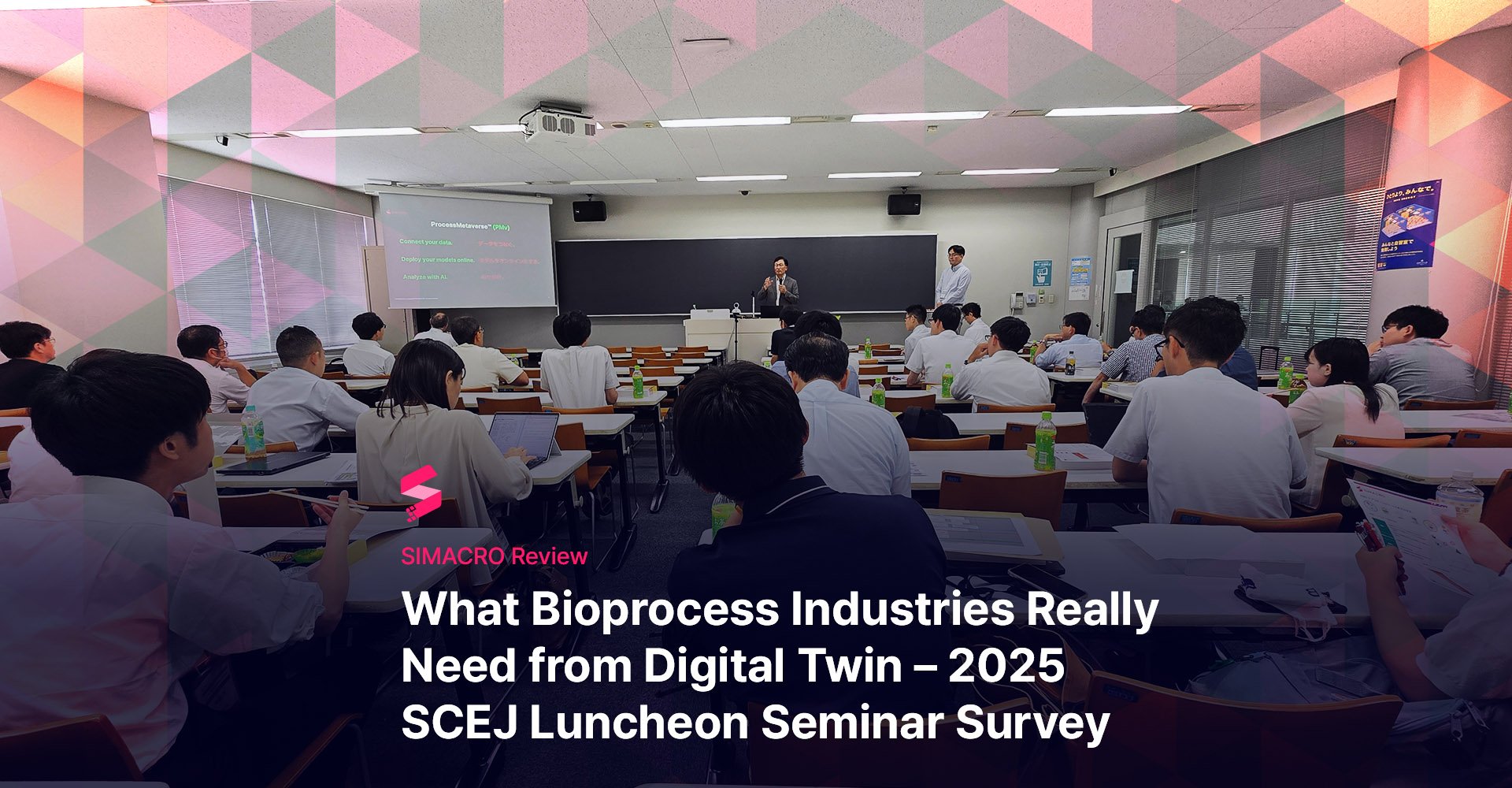
In September 2025, a special seminar was held at the 56th Annual Autumn Meeting of the Society of Chemical Engineers, Japan (SCEJ). At the SCEJ Luncheon Seminar hosted by Simuarts, Dr. Jay Yun (CEO) and Dr. Jun-Woo Kim (Technology Director) from SIMACRO presented "Smart Operation and Control of Biochemical Processes Using ProcessMetaverse™ (PMv)."During this seminar attended primarily by Japanese bioprocess industry professionals, SIMACRO conducted a survey on digital twin. The results clearly revealed the expectations and priorities that bioprocesses hold for digital twin technology.While digital twin technology is widely discussed, the key question is:"What does the bioprocess industry actually want from digital twin?"This article analyzes the survey's key findings and examines the core challenges and directions that the bioprocess industry seeks to address through digital twin.
Digital Twin Adoption: High Interest, Low Implementation
First, let's examine the current status of digital twin adoption in the bioprocess industry.
Q. What is the current status of digital twin implementation at your organization?
Already Implemented – 4%
Under Consideration – 56%
Others (Including No Plan) – 40%
The survey reveals both high bioprocess industry interest in digital twin and the difficulty of actual implementation. While over half of respondents (56%) are considering digital twin adoption, only 4% have actually implemented it.This gap indicates that while digital twin technology is no longer an unfamiliar concept, significant barriers exist in converting conceptual interest into actual implementation. Given the complexity of bioprocesses and the nature of working with living systems, technical complexity and uncertainty about return on investment create particularly significant challenges.
Core Functions: Insight Generation and Real-time Optimization
The question about the most needed functions in digital twin reveals clear bioprocess industry direction.
Q. What features do you think are most needed in a process digital twin solution? (Multiple selections possible)
Data Analysis & Insight Generation – 33%
Real-time Optimization – 31%
Real-time Prediction: Operational Scenario-Based Simulation (What-if Analysis) – 25%
Infrastructure for Autonomous Plant Operation – 8%
Others – 2%
Data analysis & insight generation (33%) and real-time optimization (31%) received the highest shares. This demonstrates that participants want active functions that go beyond simple monitoring or visualization to derive meaningful insights from data and optimize operations in real-time.The differentiating value from traditional monitoring systems lies precisely in 'actionable insights.' The industry demands platforms that go beyond displaying data to analyze it, provide meaningful insights, and enable real-time optimization decisions based on those insights.Real-time prediction (operational scenario-based simulation, What-if analysis) ranking third at 25% is also noteworthy. This shows strong demand not just for understanding current states, but for simulating various scenarios in advance to make optimal decisions.
Expected Benefits: Quality and Stability Take Priority
What benefits does the bioprocess industry expect from digital twin adoption?
Q. If you were to implement a PMv solution in your plant, what benefits would you expect? (Multiple selections possible)
Operational Stability & Quality Control – 44%
Yield Increase – 26%
Energy Management – 18%
Carbon Footprint Monitoring – 12%
Operational stability & quality control ranked first at 44%. This clearly shows that maintaining consistent quality and operational stability are the most important challenges in the bioprocess industry.In bioprocesses, even minor changes in process conditions such as temperature, pH, or dissolved oxygen can significantly alter microbial or cellular metabolic activities, directly impacting final product quality. Therefore, maintaining consistent quality is the most critical challenge.Additionally, bioprocesses often operate in batch or fed-batch modes, making it even more difficult to achieve consistent quality across batches. digital twin can play a crucial role in reducing batch-to-batch variability and achieving consistent results.Yield increase ranked second at 26%, while sustainability-related items such as energy management (18%) and carbon footprint monitoring (12%) also received significant shares. This indicates companies' intention to secure quality and stability through digital twin while simultaneously achieving productivity and sustainability.
Overall Insights: Bioprocess Industry's Unique Requirements
Synthesizing the SCEJ Luncheon Seminar survey responses reveals clear patterns:Priority Functions: Data Analysis & Insight Generation (33%) + Real-time Optimization (31%)Core Expected Benefits: Operational Stability & Quality Control (44%) > Yield Increase (26%)Characteristics: Decision support-focused, low interest in automation (8%)Practical Challenge: Low implementation rate (4%) despite high interest (56% considering)Bioprocesses work with living microorganisms or cells, and they are complex systems with high variability and unpredictability. Therefore, rather than complete automation, providing meaningful insights from data and supporting operator decision-making is more realistic and effective.
Conclusion: Intelligent Solutions for Bioprocesses
Digital Twin Strategy Differences Across Industry Sectors
In May 2025, SIMACRO held the PMv Global Launch Demo Day in Seoul for Asian chemical companies and conducted a survey (View Demo Day Survey Results).Comparing the Japanese bio-focused SCEJ survey with the Asian chemical-focused PMv Demo Day survey from May reveals that different industry sectors require distinctly different conditions from digital twin.Japanese bioprocess industry (September SCEJ)
Core Functions: Data Analysis & Insights (33%) + Real-time Optimization (31%)
Autonomous Operation Infrastructure: 8% (lowest)
Top Priority: Operational Stability & Quality (44%)
Asian Chemical Industry (May Demo Day)
Core Functions: Real-time Optimization (36.5%) + Autonomous Operations Infrastructure (26.9%)
Autonomous Operations Infrastructure: 26.9% (2nd)
Top Priority: Yield & Efficiency (32.7%)
The most significant difference lies in interest in automation. The Asian chemical industry ranked autonomous operations infrastructure at 26.9% (2nd), while the Japanese bioprocess industry recorded only 8% (lowest). This reflects fundamental differences in the nature of these industries.Chemical processes, based on relatively predictable and stable physicochemical reactions, show higher interest in building autonomous operation systems. In contrast, bioprocesses, due to the inherent complexity of working with living microorganisms or cells, prefer decision support systems that assist operators' professional judgment rather than complete automation.Expected benefits also show clear differences. The Japanese bioprocess industry prioritized quality control (44%), while the Asian chemical industry gave relatively balanced importance to yield/efficiency (32.7%) and quality control (23.1%). This demonstrates how challenging and critical it is to maintain consistent quality across batches in bioprocesses.
Core of Bioprocess Digital Transformation
Digital transformation in bioprocesses requires a different approach than chemical processes. Survey results reveal three core conditions that the bioprocess industry requires from digital twin.First, the ability to provide meaningful insights by analyzing data from complex biological systems. Bioprocesses involve numerous variables interacting in complex ways, making it essential to extract meaningful patterns and insights beyond simple data visualization.Second, functionality to continuously monitor and control operational stability and quality to achieve consistent results across batches. Given the batch operation characteristics of bioprocesses, maintaining consistent quality throughout each batch—from start to finish—is the most critical challenge.Third, decision support systems that support and enhance operators' professional judgment rather than complete automation. Due to the complexity and uncertainty of bioprocesses, human operators' experience and intuition remain crucial.SIMACRO's core competency lies in combining advanced modeling and simulation with integrated data management, contextualization, real-time data analysis, and AI Agent technologies to implement intelligent systems that understand bioprocess complexity and support operator decision-making.The bioprocess industry is a key sector opening pathways to a sustainable future across diverse fields including pharmaceuticals, biofuels, food, and cosmetics. Leveraging proven expertise in global collaborations and digital engineering, SIMACRO aims to lead digital transformation that meets the unique requirements of the bioprocess industry.With headquarters in Boston and Seoul, SIMACRO has completed over 90 commercial modeling projects across 40 companies since 2018. Collaborating with global technology leaders such as AspenTech, Emerson, and OLI, SIMACRO is committed to advancing digital innovation in the process industry.About SIMACRODesigner