
How SIMACRO combined decades of process engineering expertise, physics-based simulation, and AI-powered automation to advance a complex renewable natural gas digital twin.
The Challenge: When Individual Models Work, but the Whole Process Doesn't
Developing an accurate process model is challenging; making several complex models work together efficiently is an entirely different problem. This was the situation facing a U.S. renewable natural gas (RNG) operator trying to simulate an integrated gas processing facility.
The plant involves several connected processes: carbon removal, membrane separation, compression and nitrogen rejection. Each comes with its own modeling requirements and computational demands. While individual simulation models existed, integrating them into a reliable plant-wide workflow remained difficult. The nitrogen rejection unit (NRU), with its cyclic adsorption process, presented a particular challenge. The NRU is different from conventional steady-state simulations. Adsorption in the NRU involves rapid pressure, composition and operating sequence changes across multiple beds.
Simulating every component at full detail created excessive computational complexity and convergence issues. The operator needed a practical, integrated environment that could respond to changing plant conditions and support what-if scenario analysis. This would be a foundation for a functional digital twin.
Engineering Expertise Comes First
At SIMACRO, engineering depth anchors every project. The team brought decades of experience in process simulation and thermodynamics. They also had deep expertise in dynamic modeling and separation process design. Experts reviewed existing Aspen-based models, tuned membrane and compressor parameters, and investigated the complex NRU operating sequences. Historical operating data was used to refine model inputs, and process value inconsistencies were reconciled before the data was used.
One key technical challenge was time-scale mismatch. The NRU cycles rapidly across beds, while other units change slowly. Forcing tight coupling across these time scales would increase solver demands without practical value, so SIMACRO balanced granular simulation detail with operational tractability.
Where detail mattered, such as NRU adsorption, full rigor was maintained. Where broader insight and speed were needed, reduced-order models (ROMs) were developed. The objective was physically trustworthy and repeatable results, not just a working simulation file.
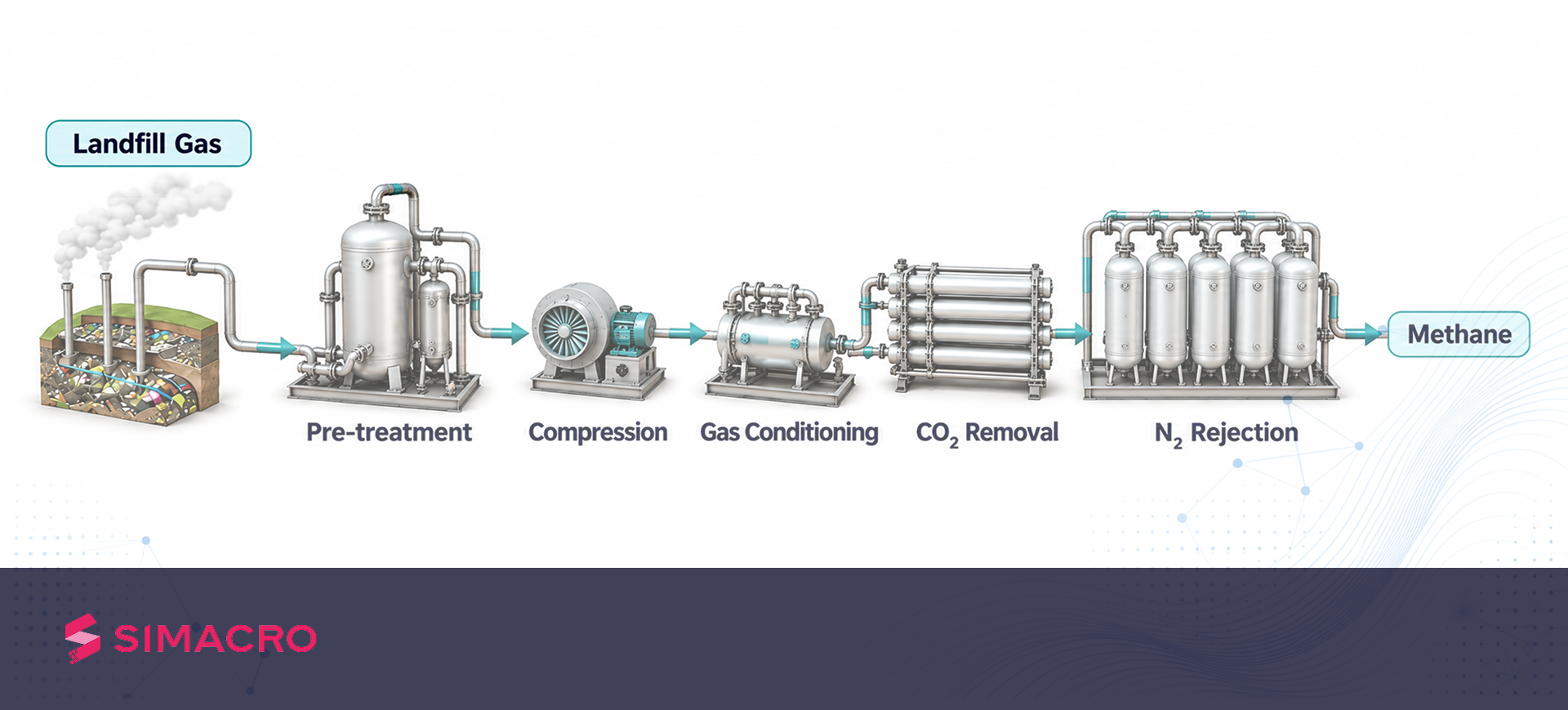
From Computation to Decision: Making Rigorous Models Practical
Detailed adsorption models are invaluable for engineering insight, but rapid scenario evaluation is often limited by computational cost. Traditional workflows require repeated manual tuning and batch runs. This is feasible for a few scenarios but unscalable for many.
Routine questions come up daily: what if the feed changes? What if composition varies? What if throughput is adjusted? Each of these requires running dozens or hundreds of scenarios. Usually this is done iteration by iteration.
Bringing PMV™ and AI into the Engineering Workflow
SIMACRO’s ProcessModel V™ (PMV™) served as the central platform for integrating models, managing simulations and data, and visualizing plant KPI results.
For this project, PMV™ linked rigorous Aspen models built in Aspen Plus/Dynamics and Aspen Custom Modeler. It also linked models from Aspen Adsorption. These models covered the full plant and included the NRU and membrane sections. The models came together into one accessible workflow. Engineers generated hundreds of NRU simulation cases. Each had 20 adsorption cycles and provided reference data for reduced-order modeling. Using this data, the team tested machine learning algorithms from regression to neural networks. They identified those that best replicated the rigorous NRU model’s response to changing plant conditions.
The Operational Outcome: A Connected, Actionable Digital Twin
With PMV™, the operator moved from disconnected engineering files to a unified digital twin environment. Plant data was directly integrated to monitor KPIs such as methane recovery, production rate, and energy consumption in near real time. Engineers could run what-if scenarios from a browser dashboard without manual file handling.
The result: broader access and higher model usability, from advanced simulation specialists to plant engineers and tech staff. By combining engineering rigor and AI-powered automation in PMV™, the plant team can now evaluate operating scenarios, identify inefficiencies and adapt the digital twin across future RNG projects.
Written by Angela Park, Gunhak Lee
SIMACRO media team | media@simacro.com
