
MOF Carbon Capture: From 2025 Nobel Prize to Process
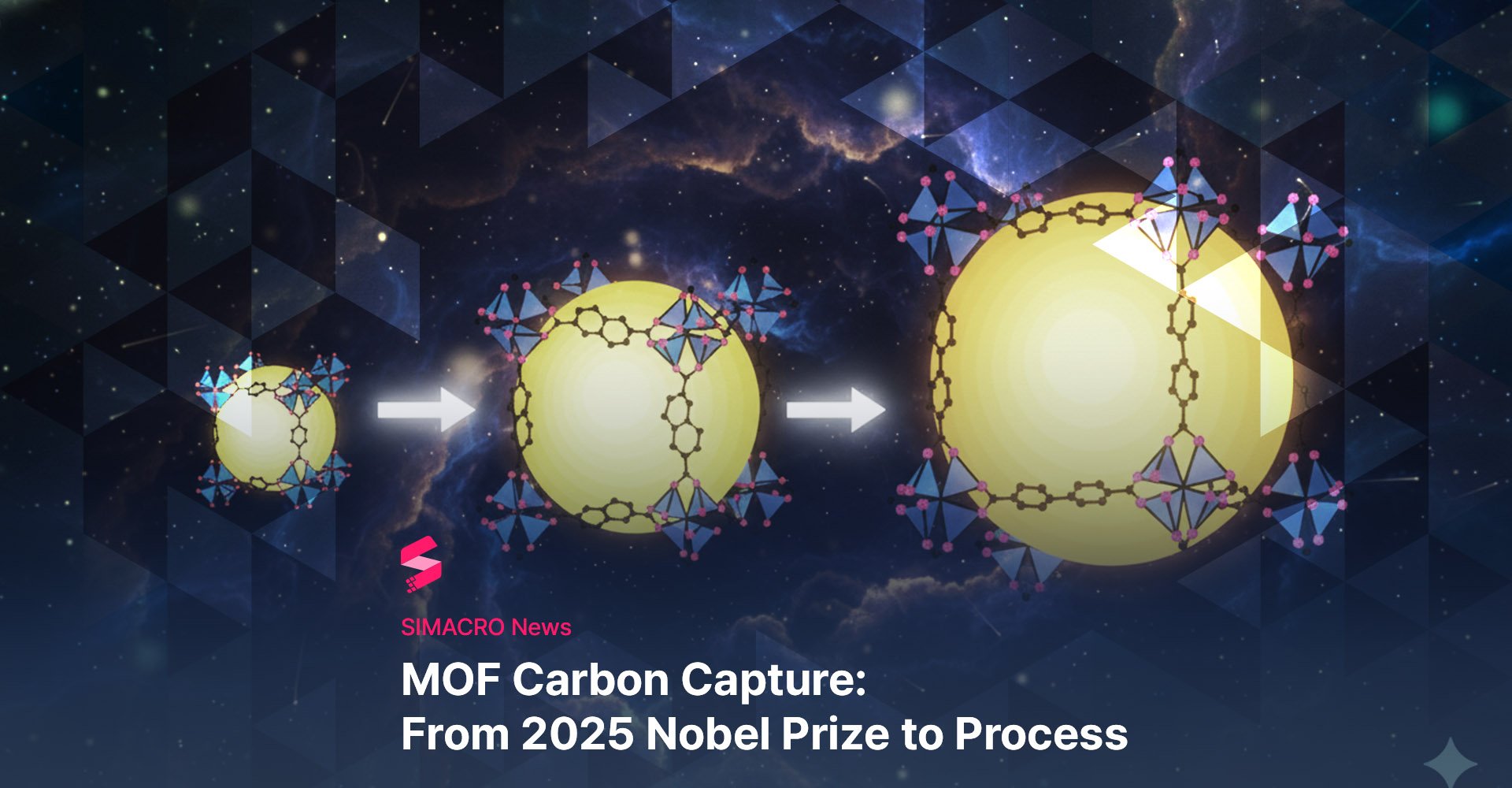
The 2025 Nobel Prize in Chemistry recognized Susumu Kitagawa, Richard Robson, and Omar Yaghi for developing "molecular architectures containing rooms for chemistry." This citation highlights Metal-organic Framework (MOF) not only as a novel material, but also as a molecular architecture increasingly discussed in the context of carbon capture applications. Specifically, the Nobel Committee highlighted carbon dioxide capture as a primary application, noting its usefulness under certain process conditions.The academic significance is undeniable. As interest in MOF-based carbon capture grows, the challenge now lies in evaluating how these materials perform when applied to real-world capture processes. The critical next step is rigorous engineering validation. Specifically, we must ensure these materials perform effectively within large-scale CCUS systems.
What is MOF? The Power of Rational Design
Conventional carbon capture and storage processes have historically relied on liquid absorbents. However, these conventional methods often require large absorption towers. Consequently, this increases footprint, capital cost, and energy intensity for regeneration.A key contribution honored by the Nobel Prize is the concept of "Rational Design" pioneered by Omar Yaghi. This means MOFs can be engineered with precision to capture specific molecules.This design flexibility allows MOF behavior to be systematically evaluated through process digital twin when applied to carbon capture systems. Because the material is rationally designed, its behavior in a carbon capture technology system can be effectively simulated and optimized using our PMv solutions.
Tunability of MOF Structures: By combining metal ions and organic linkers, MOFs can be engineered with specific pore sizes and chemical properties, offering tailored solutions for applications like carbon capture. ©NovoMOF
Technical Specificity: Surface Area and Selectivity
The classification of MOF as a next-generation carbon capture technology is supported by distinct material properties that translate into process advantages.First, the high surface area allows for a higher density of CO₂ adsorption. MOFs can exhibit internal surface areas exceeding several thousand square meters per gram. This characteristic can contribute to reducing the physical dimensions of capture units, addressing the footprint constraints of industrial sites.Second, tunable selectivity allows engineers to optimize the material's affinity for CO₂. This tunability helps identify pathways to reduce regeneration energy requirements. Therefore, it serves as a primary driver for lowering the operating expenses (OPEX) of CCUS facilities.
Overview of MOF-based Carbon Capture Process: The mechanism of selectively adsorbing and separating CO₂ from flue gas streams to recover pure carbon. ©NovoMOF
SIMACRO Approach: Validating Commercial Viability
To bridge the gap between material science and industrial application, SIMACRO collaborated with NovoMOF(Switzerland), a leader in high-performance MOF production with deep roots in the research of Nobel laureate Omar Yaghi.SIMACRO utilized lab-scale data provided by NovoMOF to perform process digital twin and Techno-Economic Analysis (TEA).
Scale-up Simulation:We used digital twin-based simulations to assess performance changes. Specifically, we analyzed the shift from lab-scale data to commercial-scale assumptions.
Process Optimization & Evaluation:The study involved assessing regeneration energy requirements and optimizing process integration to achieve target purity and recovery rates.
This collaboration is significant as it evaluates the specific process conditions required for deploying MOF-based carbon capture technology. It also demonstrates a global partnership model in climate tech, integrating Swiss material science with Korea’s digital engineering capabilities.
Professor Omar Yaghi, 2025 Nobel Laureate in Chemistry. As the pioneer of Reticular Chemistry and MOFs, his foundational work on "Rational Design" is now translating into industrial-scale climate solutions.©Nobel Prize Outreach. Photo: Anna Svanberg
Conclusion: Digital Engineering for Net Negative Outcomes
As Daniel Steitz, founder of NovoMOF, noted, “The question is no longer 'if' MOFs will be used in industry, but 'how fast'.” SIMACRO’s process digital twin expertise plays a pivotal role in accelerating the adoption of MOFs.Digital twin serves as a vital tool to reduce physical trials and identify efficient pathways for technology deployment.SIMACRO remains committed to advancing the global climate tech ecosystem by providing the engineering insights needed to scale CCUS solutions effectively.
Related Articles
Advancing Direct Air Capture: Digital Engineering for Carbon Removal Technology
Climate Tech Innovation: Building a Sustainable Future with Global Partners
With headquarters in Boston and Seoul, SIMACRO has completed over 90 commercial modeling projects across 40 companies since 2018. Collaborating with global technology leaders such as AspenTech, Emerson, and OLI, SIMACRO is committed to advancing digital innovation in the process industry.About SIMACRODesigner