
Two-Model Approach: Revolutionizing Digital Twins from Mirroring to Autonomous Operation
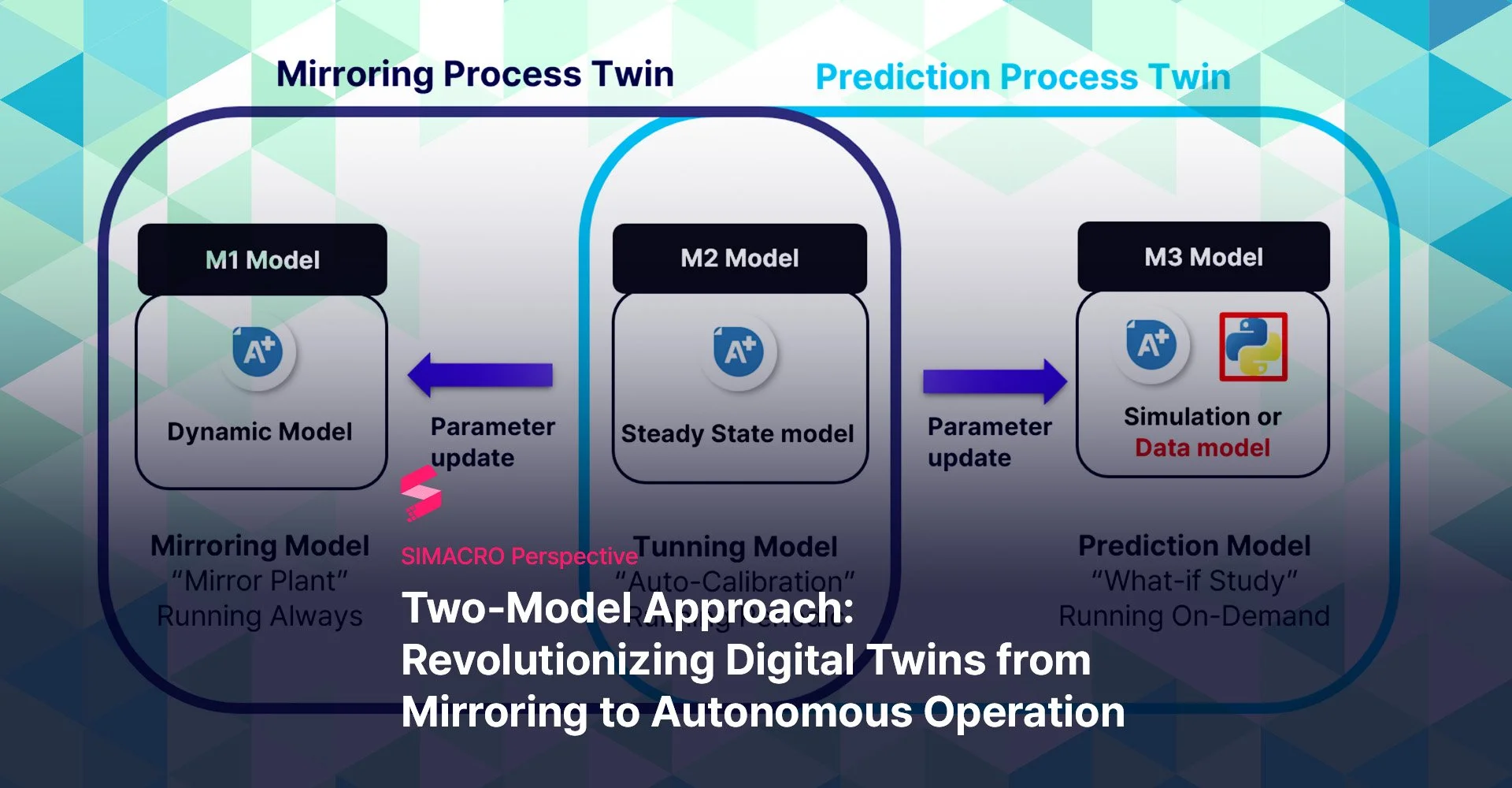

Understanding the M1+M2+M3 Architecture for Process Digital Twins
The concept and implementation of online digital twin in the process industry are undergoing fundamental changes. While many still perceive online digital twin as merely connecting real-time data with simulation models and visualizing calculation results, the reality requires far more sophisticated concepts and methodologies. True online process digital twin must continuously reflect equipment performance degradation and quickly adapt to various operational situations when new production strategies for cost-effectiveness are established.When Wonseok Lee, Executive VP of Operations at SIMACRO, shared insights about the Two-Model Approach (M1+M2) on LinkedIn, it generated significant interest from process industry professionals. The post explained the role and purpose of mirroring digital twin as the first stage of online process digital twin and contained insights about the Two-Model Approach (M1+M2) for implementation. The comments section sparked in-depth questions and discussions on various topics including implementation complexity, evolution toward autonomous operation, and real-world application cases.To make these insights more accessible to a broader audience, we have compiled them into this comprehensive article.
The Evolution of Digital Twin : Beyond Simple Mirroring
Many people still think of mirroring as simply feeding real-time data into the model and obtaining simulation results. However, in chemical processes and equipment, degradation inevitably occurs over time, such as fouling factor increase, compressor efficiency drop, and catalyst deactivation.Therefore, true mirroring must go beyond obtaining results from real-time data. It must also include periodic parameter calibration to account for degradation.
SIMACRO's Two-Model Approach
SIMACRO's PMv (ProcessMetaverse) enables easy implementation of Two-Model methodology-based mirroring digital twins.M1 (Mirror Model): As a dynamic model, it projects the plant's operational conditions and behavior, with real-time operational data input to maintain synchronization with the plant.M2 (Calibration Model): As a steady-state model, it runs periodically and adjusts parameters (e.g., fouling factors, rotating equipment efficiency, catalyst activity) to minimize differences between the plant and mirror model.Critically, for M1 and M2 to maintain an organic relationship and practical synchronization, the simulation software must support Open-Form Equations. This structure enables flexible parameter calibration in the M2 model and ensures seamless updates of new parameters to the M1 model.Through this approach, PMv enables not only running simulation models with real-time operational data input, but also true digital twin stage 1 mirroring that reflects the plant's degradation state over time.
Online Process Digital Twin : Why Two-Model Approach (M1 + M2)?
Some people asked why the Two-Model Approach (M1 + M2) is necessary for mirroring. The key reason is that "reproducing various dynamic states and responses of the plant" and "continuously reflecting the degradation state of equipment facilities" are important in mirroring.
Limitations of Single Steady-State Model
A single steady-state model cannot capture:
- Dynamic changes in inventory tanks like liquid levels and mass balance
- Transition phases such as start-up, shutdown, or feedstock changeover
- flow and pressure oscillation caused by recycle and feedback control loops
- Dynamic plant responses induced by control strategies and control actions
- Energy storage systems (ESS, Steam Header) where pressure/temperature or SOC change over time
- Batch or semi-batch operations that inherently require a time dimension
The Solution: Dynamic + Steady-State Integration
That's why:
- M1 (Mirror Model) is a dynamic model, always running to track the plant's dynamic states while generating continuous metadata
- M2 (Calibration Model) is a steady-state model, executed periodically to recalibrate parameters (fouling factors, efficiencies, catalyst activity) and maintain high mirroring consistency and accuracy of the M1 model in the long term
This structure enables mirroring digital twins to achieve both "continuous real-time tracking of the plant by M1" and "state alignment by M2."
Extending to Predictive Capabilities
Another advantage of the Two-Model Approach is that it can be naturally extended into a prediction digital twin. Once the mirroring loop (M1 + M2) is established, M3 model can be added to configure a prediction loop.
- M3 (Prediction Model): used for "What-if" studies, scenario analysis, and on-demand optimization
At this time, M2 model performs the same role in the prediction loop, transferring calibrated parameters to the M3 model to enable What-if analysis based on current equipment conditions.
Industry Implementation: Key Questions and Expert Insights
The M1+M2+M3 architecture has generated significant interest among process industry professionals. Here are the most critical questions raised by practitioners, along with expert insights and discussions.
Implementation Complexity and Scalability
Q: Would maintaining multiple models (M1+M2+M3) be too complex and resource-intensive for practical implementation?A:.In equation-oriented simulators like Aspen Dynamics, models such as M1 and M2 are fundamentally identical, functioning under different operating modes. The objective is not to create multiple models, but to enable a single model to perform various roles through flexible configurationThe key lies in overcoming the limitations of legacy tools, which struggle to integrate multiple first-principles models, data-driven models, and plant data while effectively managing simulation results.Modern platforms with integrated metadata management not only make multi-model digital twin feasible but also enable rapid deployment and long-term sustainability in operation . This is exactly why ProcessMetaverse (PMv) was developed as an industrial SaaS platform.For a comprehensive overview of PMv's architecture and capabilities, see this introductory video.
Future of Autonomous Plant Operation
Q: How do digital twin evolve toward autonomous operation, and what role does Gen-AI play in this transformation?A: The process industry will ultimately move toward autonomous operation, with Agentic-AI as the cornerstone technology. The metadata generated by online digital twin becomes the critical context that enables Gen-AI to operate processes reliably and intelligently.The progression will follow a natural sequence: [Mirroring (M1+M2) → Prediction (M3) → Decision Support → Autonomous Decision-making]. A digital twin platform that integrates rich operational metadata along with design data, standard operating procedures (SOPs), and various maintenance documents will serve as both the training ground and operational context for Gen-AI, establishing a continuous learning-analysis-application-correction cycle.
Creating Value for All Stakeholder
Q: How can digital twin serve the different needs of operators, engineers, and managers from a single platform?A: To generate substantial value, digital twin must deliver insights aligned with each role's specific KPIs. Recent industry surveys consistently show demand for "One Solution, Multiple Perspectives" - a unified platform that adapts its interface and insights to serve:
- Operators: Real-time operational data and alerts
- Engineers: Technical analysis tools and process optimization insights
- Management: Strategic KPI dashboards and performance metrics
The platform maintains a single data source while providing differentiated user experiences tailored to each stakeholder's requirements.
Technical Implementation and Standards
Q: What are the technical requirements for implementing dynamic mirroring, and how important are industry standards?A: The main purpose of Mirroring Digital Twin is to use sensing data as a seed and amplify it thousands of times into rich metadata. M1 (First-Principles Dynamic Model) runs continuously, typically every minute, to mimic plant operation and generate extensive soft sensing data.First-Principles M1 model are fundamentally distinguished from purely data-driven models in terms of data amplification perspective. Pure data-driven models can be more effective than First Principles models in certain cases for M3 prediction models.Regarding standards, interoperability and flexible architecture are critical factors. The Asset Administration Shell (AAS) plays an important role in enabling standardization across high-level digital twin applications, ensuring seamless integration of different industrial systems.
Conclusion: The Path to Intelligent Plant Operation
The evolution from simple mirroring to autonomous represents a fundamental transformation in process industry digitalization. The M1+M2+M3 architecture provides a stable foundation for intelligent plant operation:
- Maintains continuous synchronization with physical assets (M1)
- Ensures long-term accuracy through parameter calibration (M2)
- Enables predictive optimization and scenario analysis (M3)
As the process industry advances toward Agentic-AI-based autonomous operation, the rich metadata generated by the M1+M2+M3 architecture will become the essential foundation for reliable and intelligent plant operation.With headquarters in Boston and Seoul, SIMACRO has completed over 90 commercial modeling projects across 40 companies since 2018. Collaborating with global technology leaders such as AspenTech, Emerson, and OLI, SIMACRO is committed to advancing digital innovation in the process industry. About SIMACRODesignerWonseok Lee is Executive VP of Operations at SIMACRO. As an expert in process design, modeling, and simulation, he performed business and solution consulting in the process industry at AspenTech for 20 years.
 About Wonseok LeeDesigner