
An Operating Framework for Industrial Models
Process companies have invested extensively in process simulation, digital twins, optimization models, and machine-learning applications. They also collect large volumes of operational data through historians, laboratory systems, sensors, and production databases.
ModelOps is the operating framework for managing models throughout their lifecycle—from development and validation to deployment, monitoring, recalibration, and retirement.
In an industrial context, ModelOps ensures that physics-based, simulation, optimization, AI, and hybrid models remain accurate, traceable, governed, and aligned with changing plant conditions.
However, these assets are often managed separately. Models may remain on individual engineers’ computers, require manual data updates, or become difficult to maintain after the original project team moves on. As a result, many models that perform well during development or a proof of concept are not sustained as part of routine operations.
ModelOps addresses this operational gap.
Why Industrial Models Require Ongoing Management
An industrial model represents the process under a defined set of assumptions, parameters, and operating conditions. Those conditions do not remain static.
Feedstock composition changes. Equipment efficiency declines. Heat exchangers foul. Catalysts deactivate. Instrument bias develops. Production grades, operating modes, and control strategies are modified.
Consequently, a model that initially represents the plant accurately may become less reliable over time. The issue is not necessarily that the model was poorly developed. Rather, the physical process has changed while the model has remained unchanged.
ModelOps provides a structured method for identifying, evaluating, and reducing this gap. It treats models as living operational assets that must be continuously monitored, recalibrated, validated, approved, and updated.
The objective is not to claim that a model will perfectly reproduce every plant condition. The objective is to maintain sufficient alignment between the model and the physical process for the model to remain reliable within its defined operating scope.
The Role of a Staging Environment
A central requirement of ModelOps is a dedicated staging environment.
In conventional software development, changes are not typically deployed directly into production. Code is first tested in a controlled environment, where its performance and potential impact can be evaluated.
Industrial models require the same separation between development and production.
A ModelOps staging environment allows engineers to connect recent plant data, evaluate model error, modify parameters, test revised configurations, run scenarios, and validate performance without affecting the live operating system.
This environment supports a controlled lifecycle such as:
Development → Staging → Validation → Approval → Production → Monitoring → Recalibration
The staging environment also reduces deployment risk. Engineers can verify that a revised model remains physically consistent, converges under expected operating conditions, and produces results within acceptable tolerances before it is used for operational analysis or decision support.
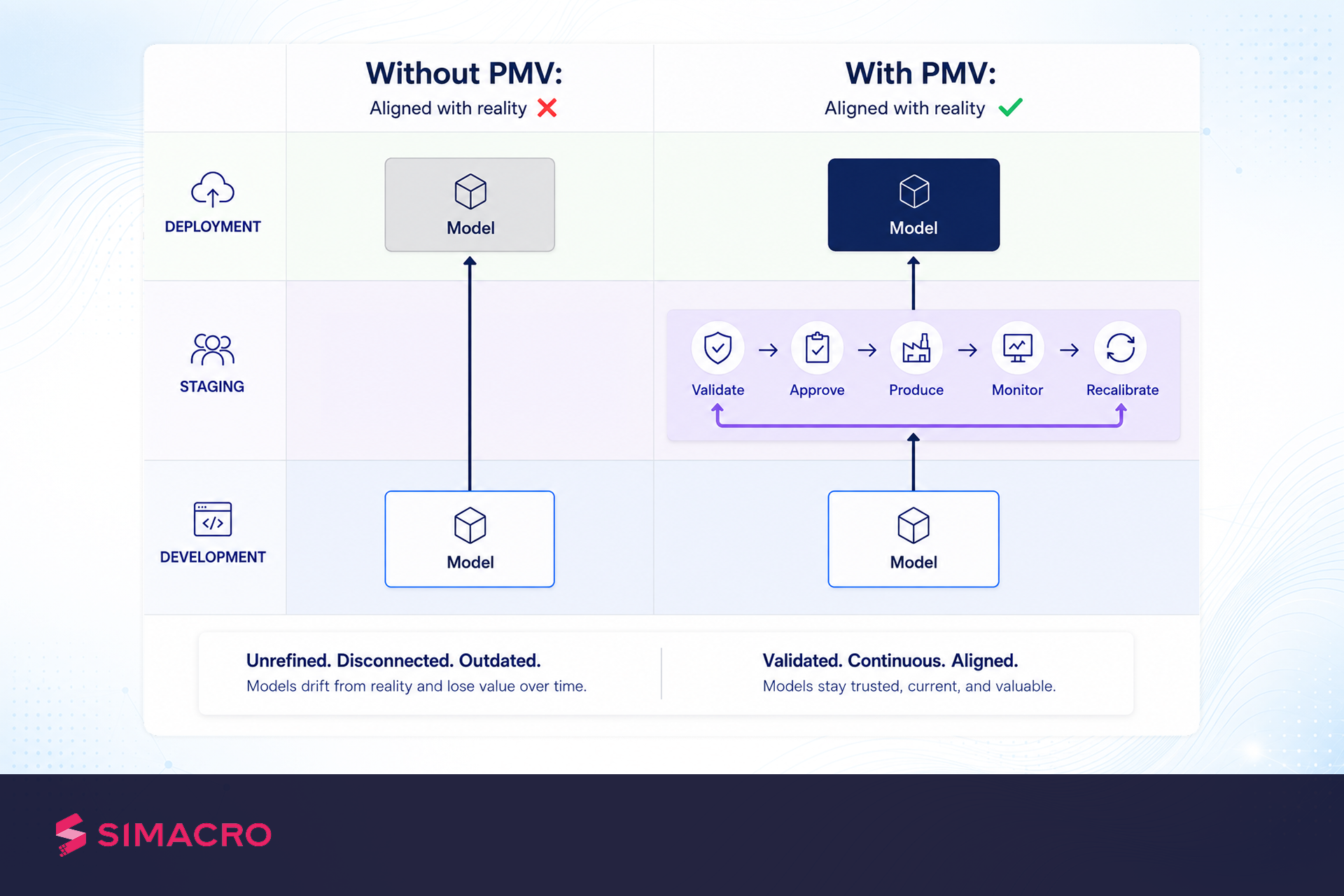
ProcessModel V™ (PMV™) allows a staging environment, where models can be validated, approved, produced, monitored, and recalibrated to align with reality. This is possible because PMV serves as a platform where OT/IT data can be safely connected, models can be run, fine-tuned, and optimized iteratively until the model aligns with reality.
From Individual Files to Governed Assets
ModelOps is not limited to model storage or version control. It defines how models are governed and operated across their lifecycle.
This includes managing:
Model ownership and approval authority
Version and configuration history
Inputs, outputs, and data mappings
Applicable operating ranges
Parameter changes and calibration records
Validation criteria and test results
Execution status and calculation logs
Dependencies between models
Deployment and retirement status
This structure allows models to be maintained systematically rather than through manual file transfers and undocumented engineering adjustments.
It also supports scalability. Once a model has defined interfaces, validation procedures, operating limits, and deployment rules, it can be reused across teams, connected to other models, or adapted for similar production lines and facilities.
Without ModelOps, each new digital twin deployment tends to become a separate engineering project. With ModelOps, models can be managed through repeatable processes and standardized operating controls.
ProcessModel V™ as an Industrial ModelOps Layer
SIMACRO’s ProcessModel V™ is designed to provide an Industrial ModelOps layer for connecting and operating engineering and AI models.
ProcessModel V™ does not replace existing process simulators, data platforms, or machine-learning tools. It provides an environment in which these assets can be registered, connected to operational data, executed, validated, monitored, and managed through a common workflow.
Physics-based models, dynamic simulations, optimization models, AI models, and hybrid models can be operated individually or combined into model chains. Changes can be evaluated in a staging environment before an updated model is promoted into production.
This creates a controlled process for keeping models aligned with current plant conditions.
As the gap between the model and the physical process is continuously identified and reduced, models remain more accurate, traceable, and usable. Once this lifecycle is standardized, digital twins become easier to scale across multiple users, processes, and facilities.
ModelOps therefore provides the operating structure required to move industrial models from one-time project deliverables into governed, maintainable, and scalable enterprise assets.
Written by Angela Park
SIMACRO media team | media@simacro.com
