
Evolution of Separation Processes: From Distillation Workhorses to Precision Chromatography (Part 1)
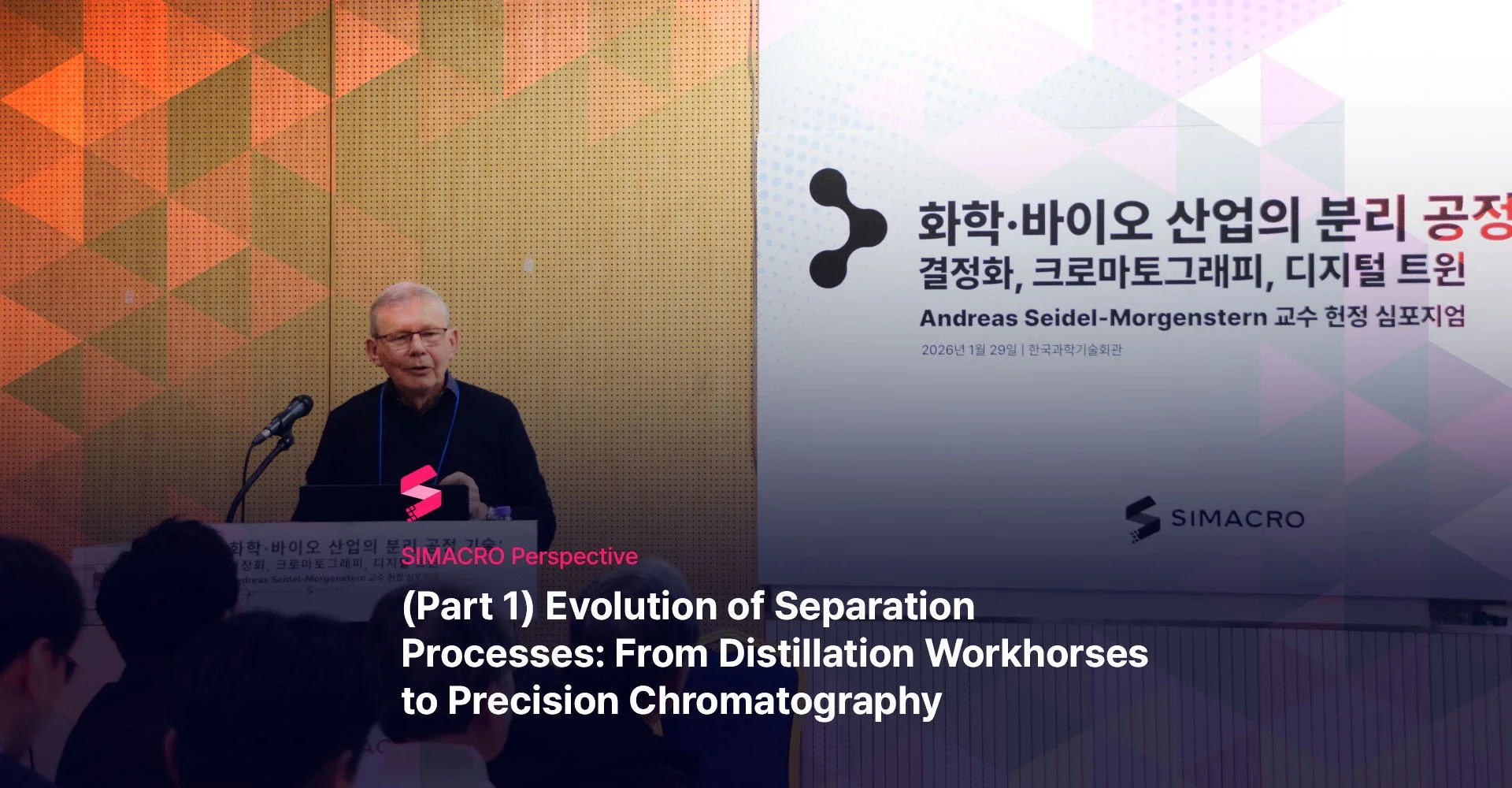
The chemical process industry relies on the precise transformation of raw materials into high-purity products. While chemical or biochemical reactions often take center stage, separation processes represent the essential "post-processing" phase that determines final product quality and economic viability. This article summarizes key insights from a special session held in Seoul by Professor Andreas Seidel-Morgenstern (ASM), a world-renowned academic leader in chemical process engineering and former Director at the Max Planck Institute for Dynamics of Complex Technical Systems. Professor Seidel-Morgenstern has been a key academic collaborator with SIMACRO’s leadership, working to bridge the gap between complex thermodynamic theories and industrial applications. In Part 1 of our review of Professor ASM’s session, we explore the foundational "workhorses" of separation and the modern challenges they face.
Managing Distillation Energy Intensity Using Digital Twin
In the core curriculum of chemical engineering, distillation is considered the primary workhorse. It exploits vapor-liquid equilibrium to split mixtures based on boiling points. However, its widespread use comes with substantial energy and infrastructure demands. Global energy consumption attributable to distillation units is approximately 230 gigawatts (GW), comparable to the total energy demand of the United Kingdom. While the McCabe-Thiele diagram remains a fundamental tool for designing these processes, modern industry faces two major challenges:
Energy Intensity: There is an immense need for alternatives that reduce thermal energy use and associated emissions.
Molecular Fragility: Many high-value molecules decompose when heated, rendering traditional distillation unsuitable.
To address these limitations, engineers must utilize a digital twin to evaluate alternative separation pathways that preserve molecular integrity while optimizing energy dataflow.
Precision Chromatography and Crystallization for Complex Mixtures
When the number of components in a mixture is large or when target molecules are very similar, chromatography provides a necessary level of precision. Since Mikhail Tsvet first separated plant pigments in 1903, the technology has evolved from analytical lab equipment to large-scale industrial units. Modern techniques like Simulated Moving Bed (SMB) chromatography enable continuous separation by mimicking counter-current flow. This approach is particularly effective for:
Center-cut Problems: Isolating a specific target from a complex natural extract.
Enantiomer Separation: Splitting mirror-image molecules that possess identical physical properties but different biological effects.
By integrating first principles modeling to generate a robust digital twin, SIMACRO enables organizations to visualize these complex molecular interactions. While crystallization is often used for final solid recovery, the initial precision of chromatography is what defines the efficiency of the entire downstream process.
Bridging Theoretical Science and Industrial Application
The true value of these separation methods lies in their ability to transform fragmented experimental data into actionable digital assets. To bridge the gap between theoretical science and industrial application, SIMACRO offers ProcessModel V™ (PMV™), a physics-informed AI platform designed for validating intelligent process operations. Within the secure, asset-decoupled virtual environment of PMv, organizations can capture the underlying physics of distillation and chromatography. This foundation allows for the transition from traditional batch-heavy operations to the sophisticated, continuous strategies required for modern chemical manufacturing, which we will explore in detail in the following part of this series.
Written by Hongjae Kim; Edited by Angela Park; Photos taken by Jason Won
Revised on 4/22/26 - ProcessMetaverse™ (PMv™) has been updated to ProcessModel V™ (PMV™)
SIMACRO Marketing Team | media@simacro.com